JEF Europe

Articles

The Federalist was founded in 1959 by Mario Albertini. The review theoretical foundation is based on the principles of federalism, the refusal of the exclusive concept of nation and the…

The Federalist: A Political Review: Editor: Giulia Rossolillo, 1959-today

The Federalist was founded in 1959 by Mario Albertini. The review theoretical foundation is based on the principles of federalism, the refusal of the exclusive concept of nation and the hypothesis that the supranational era of human history has begun. At the level of values The Federalist intends to serve the cause of peace.

Federalist Debate: 2001-Today

The Federalist Debate is a four-monthly review born to stimulate and feed the circulation of ideas and information among the various federalist organisations, and among these and the movements in the global civil society that are growing impetuously in all the regions of the world.

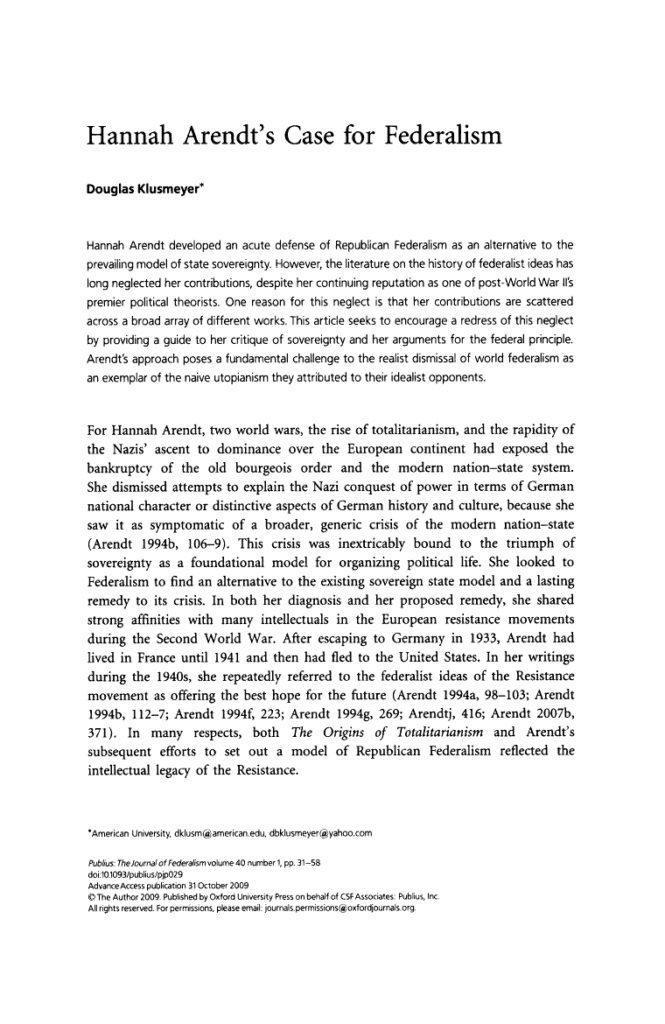
Hannah Arendt’s Case for Federalism: Douglas Klusmeyer, 2010

Hannah Arendt developed an acute defence of Republican Federalism as an alternative to the prevailing model of state sovereignty. However, the literature on the history of federalist ideas has long neglected her contributions, despite her continuing 

What Can Federalism Teach Us About the European Union? The German Experience: Tanja A. Börzel, 2011

The article uses insights from comparative federalism to reflect upon the structure and functioning of the European Union. The analysis shows that the EU corresponds rather 

Built to Last? The Durability of EU Federalism: R. Daniel Kelemen, 2007

As we approach the fiftieth anniversary of the Treaty of Rome, we again confront the question of whether the EU is on its last legs. Are today’s dire predictions any more credible than those made twenty-five years ago?

The federal approach of the European Union or the quest of unprecedented European federalism? Dusan Sidjanski, 2006

Federalism has always been a point of reference and a source of inspiration for European construction. Many European politicians, from Robert Schuman to Joschka Fischer, have 

Contours of a European Federation: Heidrun Abromeit, 2002

Many observers feel – or fear – that the European Union is going to end up in a Federation. But what kind of federation? This article contributes to a better understanding of federalism 

A directly democratic and Federal Europe: Bruno S. Frey, 1996

This paper endeavors to take up the neglected aspects of federalism and direct democracy. It emphasizes the mutual dependence of the two for reaching the goals of efficiency and trust. 

From Statism to Federalism: A Paradigm Shift: Daniel J. Elazar, 1996

Since the end of World War II and most particularly since the late 1970s, the world has been in the midst of a paradigm shift from a world of states modeled after the idea of the nation-state developed in the seventeenth century to a 

More integration, less federation: the European integration of core state powers: Philipp Genschel, Markus Jachtenfuchs, 2015

We map the pattern and extent of the European integration of core state powers (coercive force, public finance and public administration) and analyse causes and consequences. 

Why a World State Is Inevitable: Alexander Wendt, 2003

Long dismissed as unscientific, teleological explanation has been undergoing something of a revival as a result of the emergence of self-organization theory, which combines micro-level dynamics with macro-level

Brussels between Bern and Berlin: Comparative Federalism Meets the European Union: Tanja A. Börzel, Madeleine O. Hosli, 2003

In the current debate on the future European order, the European Union (EU) is often described as an “emerging federation.” This article claims that federalism is not exclusively useful in deliberating about the future of the EU.

The constitutional scheme of federalism: Andreas Auer, 2006

Federalism consists of a specific combination of self-rule (autonomy), of limited rule (superposition) and of shared rule (participation), implying the coexistence of two independent

A constructivist approach to understanding the European Union as a federal polity: Rey Koslowski, 2011

Constructivist approaches emerging in the field of international relations may be used to develop better federal theories for EU analysis by refocusing attention on political practices,

The effects of COVID-19 on EU federalism: Juan Carlos Martín Hernández, Concepción Román García, 2021
This article analyses how COVID-19 is affecting the EU federalism position in 21 Member States. The analysis is based on an ordered probit econometric model that explains the citizens’ support to a major

On ‘federal’ Ground: The European Union as an (Inter)national Phenomenon: Robert Schütze, 2009

The emergence of the United States of America in the eighteenth-century triggered a semantic revolution in the federal principle. Federalism became identified with a mixed structure

The Structure and Dynamics of EU Federalism: R. Daniel Kelemen, 2003

This article analyses European Union (EU) politics through the lens of comparative federalism. The article assesses the contributions that rationalist and constructivist

Designing Europe: Comparative Lessons from the Federal Experience: David McKay, 2001

Few dispute that one of the most pressing issues for the future of Europe is the question of constitutional design. To what extent will unanimity voting in the Council of Ministers be replaced by qualified majority voting and how

Privacy Preference Center